Best No-Prep STEM Toys for 6-Year-Olds
Low-prep STEM toys for 6-year-olds that teach through hands-on play, not worksheet fatigue.
Snapshot
| Toy | Age | Price | Best for | Link |
|---|---|---|---|---|
| #1 Learning Resources Mental Blox Critical Thinking Game | 5+ | CAD $35–$55 | Spatial logic, following directions, and co-solving | Check Price |
| #2 ThinkFun Roller Coaster Challenge | 6+ | CAD $45–$70 | Engineering logic through build-and-test coaster puzzles | Check Price |
| #3 Learning Resources Code & Go Robot Mouse | 4+ | CAD $50–$80 | Simple screen-free sequencing and robot movement | Check Price |
| #4 Educational Insights BrainBolt Boost | 5+ | CAD $30–$45 | Instant-start memory and pattern play | Check Price |
Affiliate links. Prices can change.
At six, a good no-prep STEM toy should start quickly and still leave room for real problem solving. This is the age where kids can often follow a challenge card, test an idea, and explain what happened, but they may not tolerate a long setup, tiny instruction booklet, or adult-led lesson after a full school day.
That is why "no-prep" matters. The goal is not zero cleanup or zero parent involvement forever. The goal is a toy that can move from shelf to table fast, give a clear first task, and let a 6-year-old learn through hands-on play instead of worksheet fatigue.
Learning Resources Mental Blox Critical Thinking Game
Reliable engagement, low setup friction, and strong replay value for real family routines.
This guide focuses on STEM toys that are practical, repeatable, and useful beyond the first week, especially for families who want learning value without turning playtime into a lesson plan.
What to Look For
- Fast entry. If setup is complicated, attention disappears before the first challenge starts.
- Clear feedback. Six-year-olds stay engaged when they can see whether a build, route, memory pattern, or balance worked.
- Replay value. Good no-prep STEM toys have more than one card, pattern, experiment, or way to solve the problem.
- Low adult scripting. A parent may need to model the first turn, but the toy should not require a constant grown-up narrator.
- Manageable pieces. STEM toys lose value quickly when the pieces scatter and every session begins with a search.
Our Top 6 Picks
Spatial logic, following directions, and co-solving
Pros
- ✓ Good group/sibling play
- ✓ Strong spatial reasoning
- ✓ Low-tech and classroom-friendly
Cons
- ✗ Requires reading or verbal prompts
- ✗ Pieces can scatter
- ✗ Less flashy as a gift
Engineering logic through build-and-test coaster puzzles
Pros
- ✓ Clear challenge progression
- ✓ Great cause-and-effect feedback
- ✓ Stronger novelty than another circuit kit
Cons
- ✗ Pieces need organization
- ✗ One-player-at-a-time tendency
- ✗ Harder cards may need help
Simple screen-free sequencing and robot movement
Pros
- ✓ No screen required
- ✓ Clear command-and-test loop
- ✓ Affordable Botley-style entry point
Cons
- ✗ Needs batteries
- ✗ Less complete than the full activity set
- ✗ Best with added DIY paths or obstacles
Instant-start memory and pattern play
Pros
- ✓ No pieces to manage
- ✓ Fast solo turns
- ✓ Good visual memory reps
Cons
- ✗ Electronic sound/light toy
- ✗ Needs batteries or charging
- ✗ Less open-ended than build toys
Hape Math Monster Scale
Hands-on weight comparison, counting, and early addition
Pros
- ✓ Concrete math play
- ✓ Good preschool fit
- ✓ Quiet tabletop setup
Cons
- ✗ Skews young
- ✗ Small loose weights
- ✗ Limited challenge for older kids
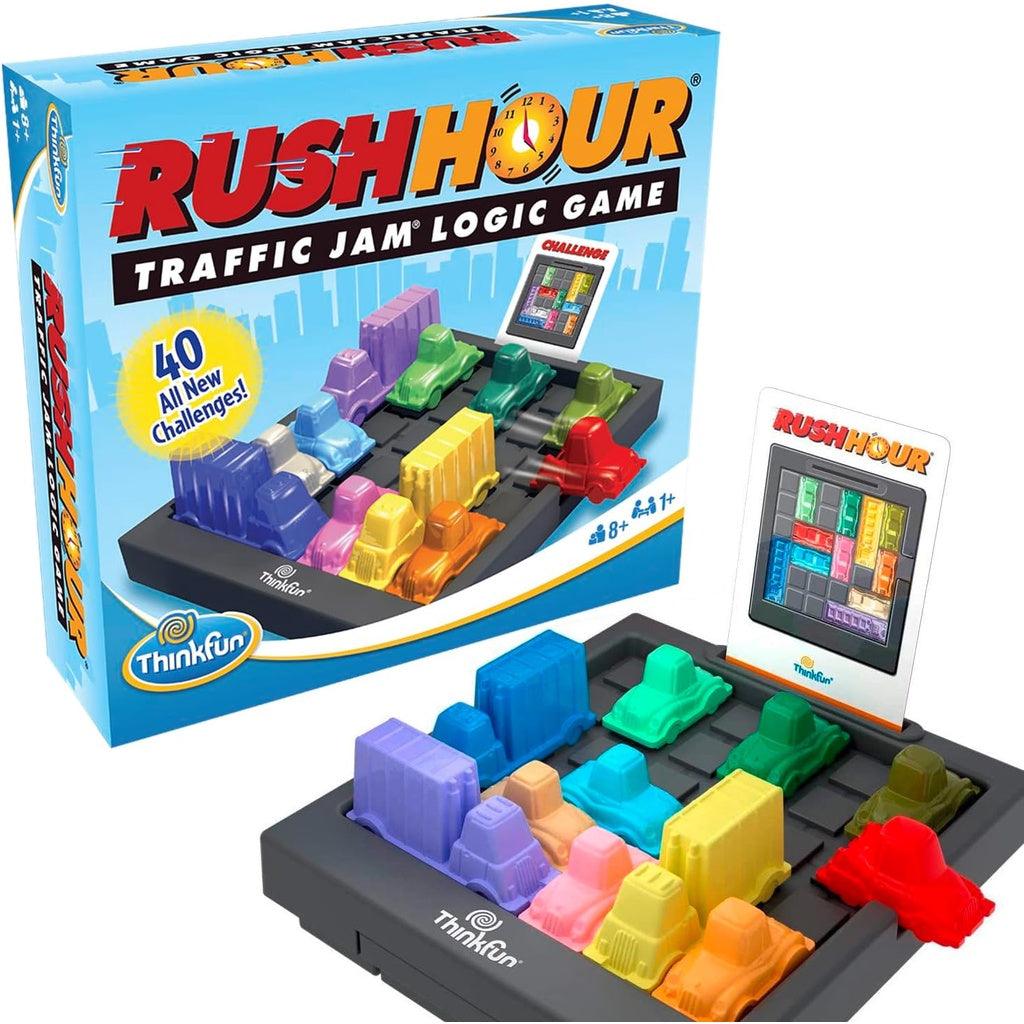
ThinkFun Rush Hour Junior
Fast-start traffic-jam logic puzzles
Pros
- ✓ Very low setup
- ✓ Clear challenge cards
- ✓ Good early logic practice
Cons
- ✗ Single-player
- ✗ Can feel repetitive
- ✗ Limited collaborative play
How to Choose a No-Prep STEM Toy for Age 6
The best choice depends less on the subject label and more on the kind of first step your child can handle. Some 6-year-olds love building and testing, which makes Roller Coaster Challenge a natural fit. Some prefer a visible puzzle with a clear answer, which makes Mental Blox or Rush Hour Junior easier to start. Others need movement and immediate cause-and-effect, where Code & Go Robot Mouse can work well.
If your child gets frustrated quickly, look for a toy with short rounds and obvious resets. A single Mental Blox prompt, one BrainBolt pattern, or one Rush Hour Junior card can be finished before fatigue takes over. If your child can persist through trial and error, a build-and-test toy may offer more growth because the solution requires adjusting several pieces.
For families with siblings, choose something that supports talking and turn-taking. Mental Blox works well for co-solving because one child can describe and another can build. Roller Coaster Challenge can become collaborative if one child places pieces and another predicts whether the marble will run. Solo puzzle toys are still useful, but they work best when the goal is quiet focus rather than shared play.
Why These Picks Made the List
Learning Resources Mental Blox Critical Thinking Game
Mental Blox is the strongest all-around no-prep pick because it teaches spatial reasoning without needing batteries, screens, or a complicated build. A 6-year-old can copy a structure, follow a verbal direction, or work with a parent or sibling to solve a prompt.
The main caution is that some prompts require reading or adult narration. That can actually be a benefit for co-play, but it means this is not always a fully independent toy for early readers.
ThinkFun Roller Coaster Challenge
Roller Coaster Challenge turns engineering into a visible build-and-test loop. Kids place track pieces, try the run, notice where it fails, and adjust. That is a useful STEM habit at six because it normalizes revision instead of treating the first mistake as failure.
The pieces need a storage plan. Use a bin, tray, or dedicated table area so setup stays quick and the toy keeps its no-prep advantage.
Learning Resources Code & Go Robot Mouse
Code & Go Robot Mouse is a good first step into sequencing because the child can see commands become movement. It is especially useful for kids who are not ready for app-based coding but enjoy robots and obstacle paths.
The simple set works best when you add small DIY challenges: reach the cheese, drive around a book, go under a chair, or follow a tape path on the floor. That keeps replay value higher.
Educational Insights BrainBolt Boost
BrainBolt Boost is the easiest pick to start. There are no loose build pieces, and the play loop is fast: watch, remember, repeat. That makes it useful for quick focus breaks or waiting-room play.
It is less open-ended than the building toys, so treat it as memory and pattern practice rather than a full STEM system. It is a good secondary toy, not necessarily the only STEM toy to own.
Hape Math Monster Scale
Hape Math Monster Scale makes early math physical. Instead of asking a 6-year-old to stare at numbers, it lets them compare weight, count pieces, and notice balance.
It skews younger than some first graders, so it is best for children who still benefit from concrete math play or for households with younger siblings. Advanced 6-year-olds may outgrow it faster.
ThinkFun Rush Hour Junior
Rush Hour Junior is a low-prep logic toy with a strong challenge-card structure. It is easy to bring out for one puzzle and put away quickly, which makes it practical for after school.
The limitation is that it is mostly single-player. If your child likes solo puzzles, that is fine. If you need sibling play, Mental Blox or a shared building challenge may be a better first pick.
Want better toy picks without the research rabbit hole?
Short, practical recommendations by age, need, and budget.
Practical Setup Tips
1) Keep the first challenge visible
Leave one card, one prompt, or one route ready to go. Six-year-olds start faster when they can see the first move immediately.
2) Use a tray for pieces
A tray turns cleanup into a boundary rather than a scavenger hunt. It also lets you pause a build and return later.
3) Praise the revision, not just the answer
Try: "You changed one thing and tested it again." That language builds a STEM mindset without turning play into a lecture.
4) Rotate by energy level
Use BrainBolt or Rush Hour Junior for quiet reset time, Mental Blox for co-solving, Code & Go Robot Mouse for movement, and Roller Coaster Challenge when your child has more patience for building.
FAQ
What makes a STEM toy "no-prep"?
For home use, no-prep means the toy can start in a few minutes without a parent building the whole activity first. Batteries, storage, or first-session modelling may still be needed, but the repeat sessions should be easy.
Are these toys too educational for a 6-year-old?
They should not feel like school. The best STEM toys for this age teach through building, balancing, remembering, moving, and solving. If it feels like a worksheet, it is probably the wrong fit for no-prep play.
What if my child gives up after one failed attempt?
Choose smaller challenges and model one calm reset: "Let’s change one piece and test again." Toys with quick feedback are useful because the child can recover before frustration takes over.
Related reads
- Best STEM Toys for 10-Year-Olds
- Best STEM Toys Under $40 for Kids
- Mental Blox vs Rush Hour Junior for Logic Skills
- Best Coding Toys for Beginners Age 6 to 8
- Gifts for Kids Who Love Science
If You Can Only Buy One
Learning Resources Mental Blox Critical Thinking Game.
It gives the best balance of low-prep setup, spatial reasoning, co-play potential, and repeatable challenge for most 6-year-olds.
Want better toy picks without the research rabbit hole?
Get concise recommendations by age, need, and budget.
Where to go next
By age
Best Bedtime Calm Toys for 6-Year-Olds
Keep the recommendations age-appropriate for your kid’s stage.
By need
Gifts for Neurodivergent Kids: A Parent's Guide (2026)
Jump to picks focused on ADHD, sensory, and regulation support.
By budget
Best Gifts for Kids Under $25 (2026)
Compare strong options in lower price brackets before you buy.
Related Articles
Best Screen-Free Math Toys for Preschoolers
Three current, hands-on math toys for preschoolers: counting, matching quantities, sorting, and early pattern work without turning play into a worksheet.
Read more →
Best Low-Noise Tabletop Logic Toys for Apartments
Three manual logic toys for apartment tables, with honest guidance on setup, storage, loose pieces, and mechanical noise.
Read more →
Monster Scale vs Mental Blox for Early Logic
A comparison for families choosing between early math comparison play and spatial logic challenges.
Read more →