Best Sensory Toys for Toddlers Ages 1–3 (2026)
Five exact sensory toys for toddlers ages 1–3, compared by play style, setup, sound, cleaning, and age fit. No water beads or generic product picks.
Snapshot
| Toy | Age | Price | Best for | Link |
|---|---|---|---|---|
| #1 Fat Brain Toys InnyBin | 10 months+ | Check current price | Putting-in, pulling-out, and shape exploration | Check Price |
| #2 Fat Brain Toys Dimpl | 10 months+ | Check current price | A quiet, one-piece push-and-pop toy | Check Price |
| #3 Fat Brain Toys pipSquigz | 6 months+ | Check current price | Suction-cup play on a smooth surface | Check Price |
| #4 Fat Brain Toys Dimpl Digits | 2+ | Check current price | Popping, counting, and number talk with an older toddler | Check Price |
Affiliate links. Prices can change.
Toddlers explore with their whole body. They press, pull, shake, carry, drop, and often mouth whatever is within reach. That makes product identity and manufacturer age guidance more important than a long list of loosely defined “sensory toys.”
This guide has five exact products with simple play loops. Each one was checked against the manufacturer’s age guidance and a current Amazon.ca listing. None is a treatment or a shortcut to a developmental outcome. The useful question is much more practical: what does your toddler already enjoy doing, and how much sound, setup, and cleanup works in your home?
Fat Brain Toys InnyBin
The six chunky shapes and elastic-sided cube create several toddler-sized actions: push in, pull out, carry, sort, and repeat. It is labelled for 10 months and up.
Quick Picks by Play Style
- For putting in and pulling out: Fat Brain Toys InnyBin
- For a simple press-and-pop loop: Fat Brain Toys Dimpl
- For suction, rattling, and bath or high-chair play: Fat Brain Toys pipSquigz
- For an older toddler beginning to notice numbers: Fat Brain Toys Dimpl Digits
- For child-controlled music and lights: Baby Einstein Take Along Tunes
Our Top 5 Picks
Fat Brain Toys InnyBin
Putting-in, pulling-out, and shape exploration
Pros
- ✓ Six chunky textured shapes
- ✓ Several ways to play
- ✓ No batteries or app
Cons
- ✗ Seven pieces need to stay together
- ✗ Elastic sides can frustrate at first
- ✗ Mixed materials need hand cleaning
InnyBin is a 5.5-inch cube with elastic bands across each side and six textured shapes. A toddler can drop a shape through a large gap, push it through the bands, reach in to pull it back out, or simply carry and inspect the pieces. The official minimum age is 10 months.
The setup is almost nothing: place the cube and two or three shapes on the floor, then add the rest when the action makes sense. Pulling pieces out is often easier than pushing them in, so start there if a younger toddler becomes annoyed. The loose shapes are large, but they are still separate pieces. Count all six after play and inspect the bands and shapes for damage before handing the set back.
Fat Brain Toys Dimpl
A quiet, one-piece push-and-pop toy
Pros
- ✓ One-piece design
- ✓ No batteries or loose accessories
- ✓ Easy to pack
Cons
- ✗ Short and repetitive play loop
- ✗ Some bubbles need more finger pressure
- ✗ Creases around the bubbles need careful wiping
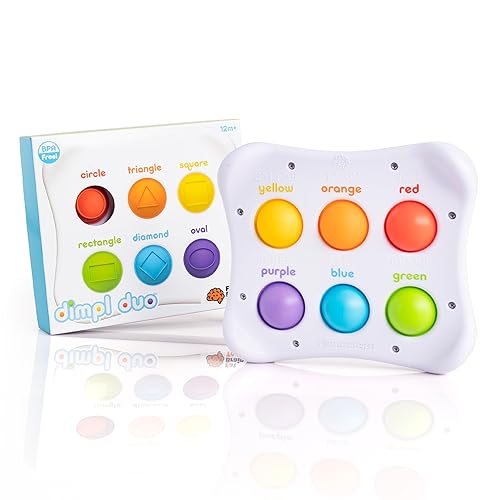
Dimpl places five silicone bubbles of different sizes inside a rigid ABS-plastic frame. Press a bubble through, turn the frame over, and press it back. Fat Brain Toys lists a minimum age of 10 months and says the toy is made without BPA.
This is the easiest pick to keep in a diaper bag or beside a high chair because there is nothing to assemble or lose. It is also intentionally simple. Some toddlers will repeat the action for several minutes; others will press each bubble once and move on. A smaller bubble can require more pressure, so an adult may need to demonstrate without turning the toy into a test. Wipe around both sides of each bubble and follow the package directions for cleaning. Do not call the silicone or BPA-free construction permission to chew it.
Fat Brain Toys pipSquigz
Suction-cup play on a smooth surface
Pros
- ✓ Three easy-to-grasp shapes
- ✓ Suction cups add a clear pull-and-release action
- ✓ Works without batteries
Cons
- ✗ Only sticks well to smooth clean surfaces
- ✗ Release makes a pop sound
- ✗ Three pieces can wander
pipSquigz is a three-piece silicone set with suction cups, textured surfaces, and rattles. Fat Brain Toys lists it for ages 6 months and up. Press the pieces onto a clean high-chair tray, bathtub wall, window, or other smooth surface. A toddler can bat, shake, twist, or pull until the suction cup releases.
The surface matters. It will not behave the same way on textured wood, fabric, or a dusty tray. Test the grip before play, and use one piece at a time if all three create too much visual or sound input. The release makes a noticeable pop, which some toddlers enjoy and others may avoid. Wash and inspect each piece according to the manufacturer’s directions, especially around the suction cups.
Fat Brain Toys Dimpl Digits
Popping, counting, and number talk with an older toddler
Pros
- ✓ Ten silicone bubbles
- ✓ English and Spanish number words
- ✓ No loose counters or batteries
Cons
- ✗ Number content is too advanced for many younger toddlers
- ✗ Still a repetitive popper
- ✗ Large frame is less pocketable than original Dimpl
Dimpl Digits is the older-toddler option. One side pairs numerals 1 through 10 with English number words; the other uses Spanish words and raised dots to count. The product is labelled for ages 2 and up.
A two-year-old does not need to recite the numbers for the toy to be worthwhile. Pressing one bubble, finding a requested colour, or touching each raised dot is enough. The number layer becomes useful gradually. Keep the language low-pressure and let the child lead the action. If your toddler wants only the satisfying pop, the original Dimpl is smaller and simpler.
Child-controlled music and lights
Pros
- ✓ Large music button
- ✓ Two volume settings
- ✓ Easy-grip side handle
Cons
- ✗ Electronic sound and moving lights will not suit every child
- ✗ Requires two AA batteries
- ✗ Official age range ends at 36 months
Take Along Tunes uses one large button to cycle through short classical melodies while coloured lights move across the front. Kids2 lists the product for ages 3 to 36 months. It has a side handle, volume control, and two AA batteries. The manufacturer says the included batteries are for demonstration, so replacing them for regular use may be necessary.
This is the only electronic pick here. Choose it for a toddler who actively enjoys predictable music and lights, not because every sensory list needs sound. Start on the lower volume and let the child press the button. The clear stop point is one song or one trip through a few favourites. Wipe it with a damp cloth and mild soap; do not immerse it in water.
What We Left Out, and Why
This page deliberately excludes water beads. They begin small, expand in liquid, and are not an appropriate toddler recommendation even with a supervision disclaimer.
Generic textured-ball multipacks, sensory bins filled with dry rice or beans, unbranded tubes, and generic wooden rainbows are also out. Their size, material, coatings, warnings, and age labels vary too much to treat the category name as one product. Kinetic Sand begins at age 3, so it is not a clean recommendation for a guide spanning ages 1 to 3.
We do not describe any pick as a teether. Toddlers may mouth toys, but silicone or BPA-free construction does not make every product suitable for chewing. Follow the product label, supervise play, inspect toys for tears or loose parts, and stop using anything damaged.
How to Choose Without Overbuying
Match the action, not a label
Watch what your toddler repeats. A child who fills containers may get more from InnyBin than from a musical toy. A child who presses buttons may prefer Dimpl or Take Along Tunes. A child who pulls objects from a tray may enjoy pipSquigz.
Offer one or two choices
A full shelf can make it harder to see what actually holds interest. Put out one active toy and one quieter option, then rotate. You do not need five products to create five kinds of play.
Count pieces and inspect the toy
InnyBin has six loose shapes and pipSquigz has three pieces. Make a quick piece count part of cleanup. Check elastic, silicone, seams, battery covers, and rigid frames regularly. Keep battery replacement and damaged-toy disposal adult-only.
Treat age labels as minimums, not promises
A product marked 10 months+ may be physically appropriate without holding every two- or three-year-old’s attention. The child’s current interests still matter. Dimpl Digits and InnyBin offer more room for older toddler play than an infant music toy, while original Dimpl is the least complicated option.
Related guides: sensory toys for ADHD kids | calming toys for autistic children | Montessori toys for 3-year-olds
Want better toy picks without the research rabbit hole?
Short, practical recommendations by age, need, and budget.
FAQ
Are sensory toys only for children with a diagnosis?
No. “Sensory” describes what the child can see, hear, touch, or move. These are ordinary play options. A toy cannot diagnose, prevent, or treat a developmental or sensory condition.
How do I know whether my toddler needs professional support?
A single toy preference does not answer that. If reactions to sound, touch, food, movement, or daily routines are frequent, intense, or interfering with family life, bring specific examples to your child’s healthcare provider. They can advise whether further assessment is appropriate.
How long should sensory play last?
There is no required session length. A toddler may repeat one action for ten seconds or return to it throughout the day. Stop when the child turns away, becomes frustrated, or starts using the product in a way the label does not allow.
Which one should I buy first?
Choose by play loop. InnyBin offers the widest range of toddler actions. Dimpl is the simplest one-piece option. pipSquigz suits a child who enjoys pulling and sound. Dimpl Digits fits an older toddler beginning to notice counting. Take Along Tunes is for a child who already likes music and lights.
Want better toy picks without the research rabbit hole?
Get concise recommendations by age, need, and budget.
Where to go next
By age
Best Montessori Toys for 3-Year-Olds (2026)
Keep the recommendations age-appropriate for your kid’s stage.
By need
Sensory, Movement, and Structured Play for Kids With ADHD
Jump to picks focused on ADHD, sensory, and regulation support.
By budget
Best Budget Sensory Toys Under $20
Compare strong options in lower price brackets before you buy.
Related Articles
Best Toys for Kids Who Rush Through Homework
Four optional short reset activities, with clear stop points, practical limits, and no promise to change homework speed or accuracy.
Read more →
Contained Bedroom Toys: Three Low-Mess Picks
Three contained bedroom toys, with storage, sound, light, timing, and shared-room limits spelled out.
Read more →
Calm Strips vs Marble Mesh Fidget for Classroom Focus
A quiet fidget comparison for school, homework, and kids who need discreet tactile input.
Read more →