Best Toys for Kids Who Rush Through Homework
Four optional short reset activities, with clear stop points, practical limits, and no promise to change homework speed or accuracy.
Snapshot
| Toy | Age | Price | Best for | Link |
|---|---|---|---|---|
| #1 ThinkFun Rush Hour Junior | 5+ | Check current price | One quiet traffic-jam puzzle card on a small table | Check Price |
| #2 Educational Insights BrainBolt Boost | 5+ | Check current price | Very short solo light-pattern rounds with no loose pieces | Check Price |
| #3 Learning Resources Mental Blox Critical Thinking Game | 5+ | Check current price | A parent-and-child spatial prompt when co-solving sounds welcome | Check Price |
| #4 The Original Stomp Rocket Stunt Planes | 5+ | Check current price | A defined outdoor launch-and-retrieve break with safe space | Check Price |
Affiliate links. Prices can change.
Rushed homework is not a toy problem. A child may be tired, hungry, eager to be finished, unsure of the work, or simply ready for a different part of the day. No toy can tell you why the work is moving quickly, make answers accurate, or replace help with the assignment.
These are optional, short activities for the space between two small homework blocks. Use one only if it sounds appealing to your child. Agree on the finish before it begins, keep the next homework step small, and stop offering activities if they add another argument. A quiet pause, snack, water, or a little space can be the better choice.
ThinkFun Rush Hour Junior
The most contained first option for a child who already enjoys quiet puzzles: set out one beginner card, use a small surface, and stop after that card rather than turning the break into a second assignment.
A Short-Reset Rule That Stays Manageable
Choose a small work unit first: one reading page, two questions, or one paragraph. Then offer one brief option, not a shelf of toys. For tabletop play, start with three to seven minutes or a single beginner challenge. For outdoor play, use one defined round and include the time needed to come back inside.
Name the stop point before the toy comes out: “one card,” “three rounds,” or “one launch per plane.” When that unit is complete, put the item away and offer one concrete next step such as opening the next page or reading the next direction together. This is a routine cue, not proof that a child is now ready to work faster or more carefully.
Four Optional Picks
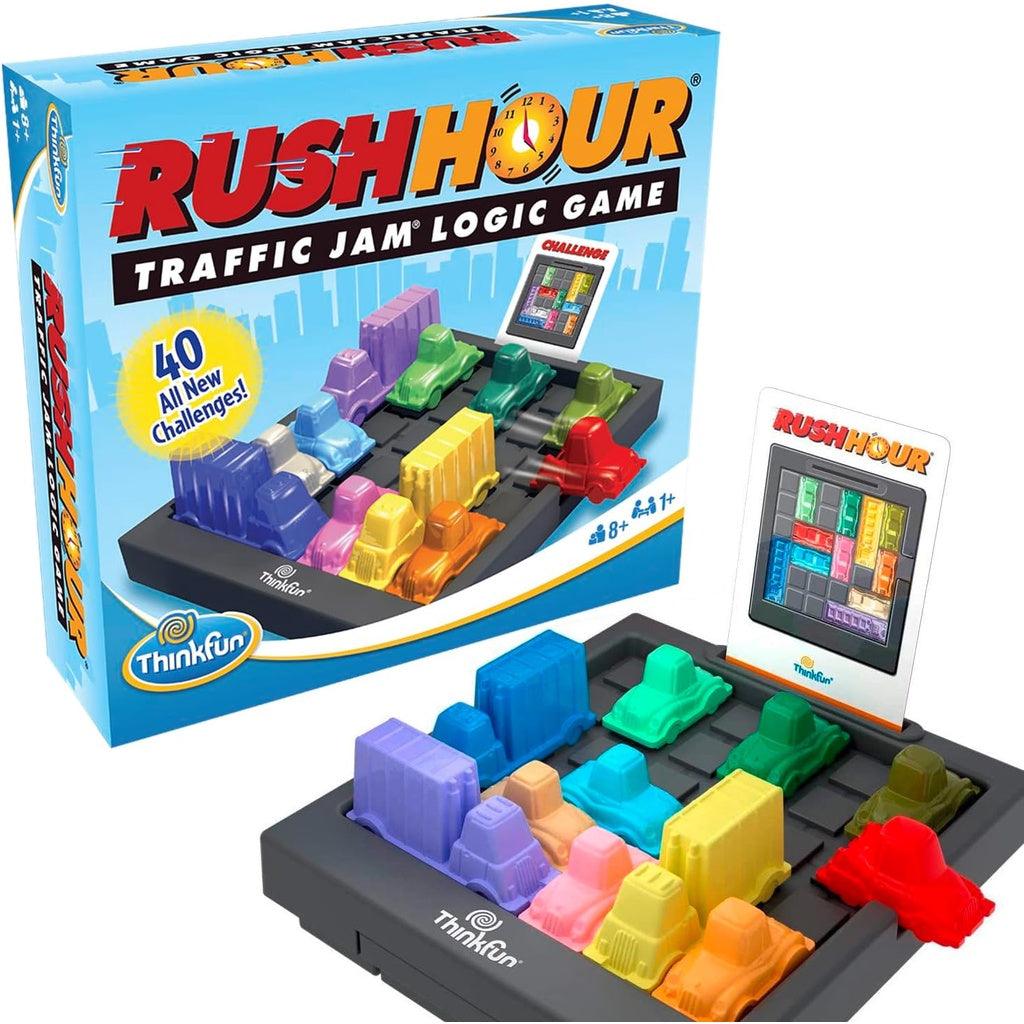
ThinkFun Rush Hour Junior
One quiet traffic-jam puzzle card on a small table
Pros
- ✓ A single card creates a defined round
- ✓ Compact tabletop setup
- ✓ No batteries
Cons
- ✗ Small vehicles and cards need collecting
- ✗ Mostly one-player play
- ✗ A stuck puzzle can add frustration
Rush Hour Junior is the strongest fit here only for a child who already likes sliding puzzles. Set out one beginner card and the pieces it needs; the child moves the vehicles to free the red car. A parent can help choose a low-pressure card and confirm the starting layout, then step back rather than narrating every move.
It is quiet apart from plastic pieces sliding on the board, but it is not piece-free. Use a tray or clear patch of table so vehicles do not end up under papers. Keep the first break to one easy card. If the child is stuck and asks for help, offer one hint, switch to an easier card, or stop. Do not turn being stuck into a lesson about persistence right before homework resumes.
Very short solo light-pattern rounds with no loose pieces
Pros
- ✓ One contained electronic game
- ✓ Fast rounds
- ✓ No cards or pieces to reset
Cons
- ✗ Lights and electronic sound may not suit a shared room
- ✗ Requires power
- ✗ Fast misses can feel discouraging
BrainBolt Boost is a light-pattern game: watch the sequence, repeat it, and begin another round. Its practical advantage is containment. Keep it near the homework area only if a light-and-sound game is acceptable there, and decide in advance whether the sound is on. It is not the quiet pick for a sibling doing schoolwork nearby.
Try three rounds or two minutes, whichever comes first. The adult job is limited to handling the three AAA batteries and holding the boundary. A child who wants another round can save that request for after homework. If a missed sequence immediately raises the temperature, put this one aside; a fast electronic game is not a required part of any reset routine.
A parent-and-child spatial prompt when co-solving sounds welcome
Pros
- ✓ Hands-on block and card play
- ✓ An adult can read the first prompt
- ✓ No screen or batteries
Cons
- ✗ Loose pieces need a tray or bin
- ✗ Takes more setup than the first two picks
- ✗ Some prompts may feel like more school
Mental Blox uses blocks and prompts for small spatial challenges. It is a better choice for a child who likes building from clues than for one who is already done with instructions. Prepare one prompt and only the pieces needed for it. A parent can read the prompt, check that the materials are together, and avoid correcting every placement.
Give it five to eight minutes, then return all pieces to the box or tray whether the prompt is finished or not. That matters because open-ended rebuilding can make the cleanup larger than the break. If the child becomes annoyed by a clue or wants the adult to take over, offer to pack it away without making the unfinished challenge a problem to solve.
A defined outdoor launch-and-retrieve break with safe space
Pros
- ✓ Three foam planes make a finite round
- ✓ No batteries
- ✓ A different option from another tabletop task
Cons
- ✗ Requires outdoor space and adult safety boundaries
- ✗ Stomping and retrieval are not quiet
- ✗ Wind and missed flights can be frustrating
Stomp Rocket Stunt Planes is for the child who would rather move than take another table break. The set includes three foam planes, a launch stand, stomp pad, and hose. Give this option five to ten minutes outdoors, including retrieval, not two rushed minutes at the door.
An adult should choose a clear launch area away from roads, windows, roofs, pets, and people, and set the line before the first launch. Make the finish one launch per plane, then count all three planes and bring the parts inside. Wind, a low launch, or a plane in a tree can end the game quickly; do not promise a stunt or chase a difficult retrieval. This is unsuitable for indoor use, apartments, bad weather, or a household that needs quiet.
No-Buy Alternatives
A purchase is optional. These low-key alternatives also have a start and finish:
- One familiar outdoor loop: walk to one agreed turnaround point and back. State the route first; skip it when weather, daylight, supervision, or the child’s preference makes it a poor fit.
- One-song movement break: play one familiar song at a household-appropriate volume. The last note is the finish. Dancing, stretching, pacing, or lying down to listen all count.
- Two quiet minutes with no questions: set a timer, offer water or a snack, and let the child choose silence. When it ends, state the next small homework step once rather than reopening a long discussion.
- A tiny helper job: carry laundry to one room, refill a water bottle, or put five books back on a shelf. Stop after the stated job; do not keep adding chores.
Choose for the Actual Moment
Use Rush Hour Junior when one contained puzzle sounds enjoyable and there is room for its pieces. Use BrainBolt Boost when a short light-pattern game will not disrupt the room. Use Mental Blox when the child welcomes a shared prompt and there is time to put blocks away. Use Stomp Rocket only with outdoor space, a safety boundary, and enough time to retrieve the planes.
None of these needs to become a reward for finishing work, a test of self-control, or a way to measure whether a child is trying hard enough. If a toy repeatedly creates bargaining, noise, scattered pieces, or more upset, it is the wrong option for that moment. Put it away and use a no-buy pause instead.
Want better toy picks without the research rabbit hole?
Short, practical recommendations by age, need, and budget.
FAQ
Will these toys make my child slow down or get homework answers right?
No. They are optional play activities with clear endings, not tools for changing homework speed, accuracy, or behaviour. Help with the assignment and the routine still needs to stand on its own.
How much adult involvement is useful?
Keep it practical: choose the space, set one clear endpoint, handle safety or first-time setup, and offer one hint if requested. If the activity requires continuous coaching, choose a simpler reset or skip it.
What if my child wants to keep playing?
Acknowledge the request, put the item away at the agreed endpoint, and name the next small task. Save another round for a time when homework is not waiting. Extending the break to avoid a conflict can make the boundary less clear next time.
What if rushed homework is a repeated school concern?
A toy cannot explain a pattern in schoolwork. Keep a few concrete examples of the work and ask the teacher what they observe in class, whether the same issue appears there, and what directions or expectations would be useful to reinforce at home.
Related reads
Want better toy picks without the research rabbit hole?
Get concise recommendations by age, need, and budget.
Where to go next
By age
Best Toys for 4-Year-Olds (Learning Through Play) (2026)
Keep the recommendations age-appropriate for your kid’s stage.
By need
Gifts for Neurodivergent Kids: A Parent's Guide (2026)
Jump to picks focused on ADHD, sensory, and regulation support.
By budget
Best Gifts for Kids Under $25 (2026)
Compare strong options in lower price brackets before you buy.
Related Articles
Contained Bedroom Toys: Three Low-Mess Picks
Three contained bedroom toys, with storage, sound, light, timing, and shared-room limits spelled out.
Read more →
Calm Strips vs Marble Mesh Fidget for Classroom Focus
A quiet fidget comparison for school, homework, and kids who need discreet tactile input.
Read more →
Best Quiet Calming Toys for Kids Who Get Overstimulated
Low-noise visual and hands-on toys for a short reset, without screens, music, or a big setup.
Read more →