Best After-School Reset Activities and Tools for 7-Year-Olds (2026)
Three quiet, low-setup activities for a 7-year-old’s after-school transition, plus simple no-buy movement and visual breaks.
Snapshot
| Toy | Age | Price | Best for | Link |
|---|---|---|---|---|
| #1 Crayola Light-Up Tracing Pad with Eye-Soft Technology | 6+ | Check current price | A quiet, one-picture creative reset with a visible finish | Check Price |
| #2 ThinkFun Rush Hour Junior | 5+ | Check current price | One short solo traffic-jam puzzle | Check Price |
| #3 Learning Resources Mental Blox Critical Thinking Game | 5+ | Check current price | Picture copying or co-solving with a parent or sibling | Check Price |
Affiliate links. Prices can change.
After school, some seven-year-olds want to talk immediately. Others need food, movement, quiet, or a few minutes without another question. A useful reset does not have to calm every child or improve homework. It just needs to be easy to begin, easy to stop, and suited to the child who came through the door that day.
This guide includes three exact products that fit age seven and three different play preferences: drawing, solo puzzles, and co-solving. The non-product ideas that follow are activities, not affiliate recommendations. Start with snack, water, and a little breathing room before deciding that the evening needs a new toy.
Crayola Light-Up Tracing Pad with Eye-Soft Technology
The strongest first pick when drawing already helps the child decompress: prepare one image and one pencil, then stop after the picture. Choose a no-buy break instead if drawing feels like more school.
Quick Match
- Drawing feels restorative: Crayola Light-Up Tracing Pad
- One clear solo problem feels good: ThinkFun Rush Hour Junior
- A parent or sibling can join: Learning Resources Mental Blox
- Any structured task feels like too much: use a no-buy movement or visual break instead
Our Top 3 Picks
A quiet, one-picture creative reset with a visible finish
Pros
- ✓ Age 6+ fit
- ✓ One image gives a clear stop point
- ✓ No paint, glue, or wet cleanup
Cons
- ✗ Requires three AA batteries
- ✗ Paper and pencils need a ready tray
- ✗ Tracing can feel school-like to some kids
The tracing pad lights a page from below so a child can copy an image onto a fresh sheet. Crayola lists it for ages 6 and up. For a seven-year-old who enjoys drawing but stalls at a blank page, that structure can make starting easier.
Prepare it before the child arrives: install three AA batteries, clip one tracing image and one blank sheet in place, and leave out one pencil. Finishing one image is the stop point. There is no paint, glue, or wet cleanup, but loose paper and pencils still need a tray or folder.
This is not the first choice for a child who experiences drawing, handwriting, or tracing as more schoolwork. It is also easy for one picture to grow into a larger project. Agree on the stopping point before play if dinner or another transition is close.
ThinkFun Rush Hour Junior
One short solo traffic-jam puzzle
Pros
- ✓ Age 5+ fit
- ✓ Forty progressive challenges
- ✓ Grid keeps play contained
Cons
- ✗ Thinking load may be wrong for a depleted day
- ✗ Primarily solo play
- ✗ Harder cards can frustrate
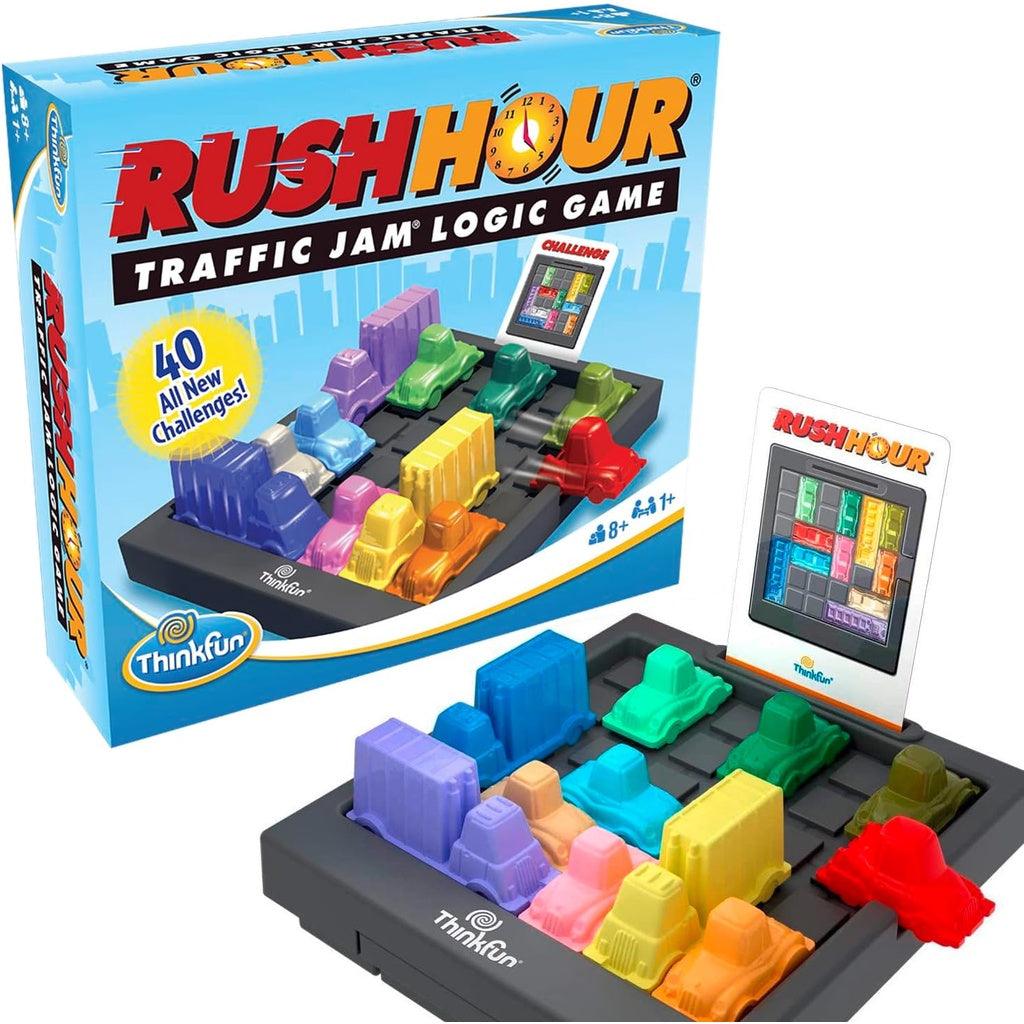
Rush Hour Junior is a sliding logic game. Select a challenge card, place the vehicles on the grid as shown, then slide them until the red hero car reaches the exit. ThinkFun lists it for ages 5 and up, with 40 progressive challenges.
For an after-school reset, choose one easy card rather than asking a tired child to continue where they last stopped. One solved card is a complete session. The grid keeps the vehicles in one play area, though the plastic pieces can tap on a hard table. A felt mat or placemat softens the sound.
Choose this for a child who relaxes into a crisp, solvable problem. Skip it on a day when any further thinking task produces angry guessing or repeated requests for an adult to solve every move. The product is quiet and contained, but it is still a logic challenge.
Picture copying or co-solving with a parent or sibling
Pros
- ✓ Age 5+ fit
- ✓ Picture and partner play modes
- ✓ Chunky pieces are easy to handle
Cons
- ✗ Twenty loose blocks need storage
- ✗ Blocks clack on hard surfaces
- ✗ Verbal challenges may need adult help
Mental Blox includes 20 plastic blocks and 20 challenge cards. Children can copy a pictured structure or play a partner version in which one person describes a build. Learning Resources lists the game for ages 5 and up.
Picture copying is the lower-demand after-school mode. Put the blocks on a tray, choose one card, build it, and return the pieces to a shallow lidded bin. One completed structure is a clear stop point. Use felt or a placemat if plastic clacking is unwelcome.
The verbal-direction mode works when a parent or sibling wants to join, but it may feel like another listening task after a long school day. Mental Blox is also less independent and more cleanup-heavy than the first two picks. Choose it when social building sounds inviting, not as a default requirement.
No-Buy Reset Options
A product is optional. These short resets use what is already at home and make the page’s activity promise more honest.
Meet the basic needs first
Offer food, water, the bathroom, and a few low-demand minutes before introducing a game or discussing homework. Hunger and fatigue can look like a toy problem when they are not.
Use three familiar movements
Choose three movements the child already knows, such as wall pushes, animal walks, reaching overhead, carrying a light household item, or walking once around the yard. Let the child pick the order. Stop after the agreed set rather than turning it into a workout.
Watch one visual object
Turn over a timer already in the house, watch rain on a window, follow a ceiling fan, or look at one familiar picture book. The point is a brief low-demand pause, not a claim that visual input will regulate every child.
Offer two choices
Try “one drawing or one puzzle?” rather than opening the whole shelf. If the answer is neither, a snack and quiet break may be the better plan. Put the unused choice away.
Define one finished unit
One image, one challenge card, one block build, or three movements is enough. A visible finish makes the next transition more predictable without imposing a universal five-, ten-, or twenty-minute rule.
A Simple After-School Sequence
1. Arrive: backpack and shoes go to their usual places.
2. Refuel: offer snack and water.
3. Pause: keep questions and instructions light for a few minutes.
4. Choose: offer one product activity and one no-buy option.
5. Finish: stop after one agreed unit.
6. Preview: state the next small step without promising that the reset will make it easy.
The sequence should serve the family, not become another performance standard. Some days the child may want company. Some days they may want to be left alone. Some days there is no useful “reset toy” at all.
How the Three Picks Differ
Setup
The tracing pad is easiest when batteries, paper, and a pencil are already prepared. Rush Hour Junior requires one card and a quick vehicle setup. Mental Blox requires a card, 20 blocks, and a storage plan.
Noise and mess
The tracing pad is the quietest and has little cleanup beyond paper. Rush Hour Junior makes light plastic tapping. Mental Blox is the noisiest of the three on a hard table and has the most loose pieces. None uses paint, slime, sand, or water.
Adult involvement
Rush Hour Junior is primarily solo. The tracing pad can be independent once it is prepared. Mental Blox is the strongest co-play option, especially in the verbal-description mode.
Frustration risk
Drawing can feel school-like. A harder Rush Hour card can turn a break into another problem to solve. Verbal Mental Blox challenges can feel demanding when listening energy is gone. Start with the easiest mode and stop if the chosen activity is making the transition worse.
What We Removed From the Old List
The former page mixed exact toys with generic weighted lap pads, worry stones, textured stickers, emotion bottles, and a visual timer that no longer had a live Amazon.ca page. Those items did not support a clean “toys for seven-year-olds” promise. Weighted products also require exact product and use guidance that a generic card cannot provide.
The Kids’ Yoga Deck was not kept as a ranked product because the exact Amazon.ca edition did not have a normal in-stock offer and the publisher age recommendation was not verified. Movement remains here as a free activity rather than a forced affiliate slot.
For broader ideas, see Best Calm-Down Toys for After School, Visual Calming Toys for Kids Who Get Overstimulated, and Calm-Down Corner Toys That Actually Help.
Want better toy picks without the research rabbit hole?
Short, practical recommendations by age, need, and budget.
FAQ
Are these activities only for children with a diagnosis?
No. This page is about ordinary after-school preferences and routines, not diagnosing or treating a condition. A child does not need a label to want quiet, movement, food, company, or time alone.
How many choices should I offer?
Start with two. One product option and one no-buy option are enough. Add more only if a small menu helps rather than stalls the decision.
What if my child rejects all three products?
Do not force a reset activity. Check food, water, fatigue, noise, and the need for space. The right response may be a snack and no questions for a while.
Should the reset happen before homework?
It can, if that fits your household. Start with food, water, and a clear end point, then try one small next task. A reset does not guarantee shorter, calmer, or better homework.
Which product should I choose?
Match the child’s preferred action. Choose Crayola for drawing, Rush Hour Junior for one solo puzzle, and Mental Blox for building with another person. If none sounds restful after school, use a no-buy option instead.
Want better toy picks without the research rabbit hole?
Get concise recommendations by age, need, and budget.
Where to go next
By age
Best Homework Break Toys for 7-Year-Olds
Keep the recommendations age-appropriate for your kid’s stage.
By need
Gifts for Neurodivergent Kids: A Parent's Guide (2026)
Jump to picks focused on ADHD, sensory, and regulation support.
By budget
Best Gifts for Kids Under $25 (2026)
Compare strong options in lower price brackets before you buy.
Related Articles
Best Toys for Kids Who Rush Through Homework
Four optional short reset activities, with clear stop points, practical limits, and no promise to change homework speed or accuracy.
Read more →
Contained Bedroom Toys: Three Low-Mess Picks
Three contained bedroom toys, with storage, sound, light, timing, and shared-room limits spelled out.
Read more →
Calm Strips vs Marble Mesh Fidget for Classroom Focus
A quiet fidget comparison for school, homework, and kids who need discreet tactile input.
Read more →