Best After-School Reset Toys for 6-Year-Olds
Transition-friendly toys to help 6-year-olds decompress after school before homework and dinner.
Snapshot
| Toy | Age | Price | Best for | Link |
|---|---|---|---|---|
| #1 The Kids' Yoga Deck | 4+ | CAD $20–$35 | Guided movement breaks and body-awareness practice | Check Price |
| #2 Sensory Body Sock | 3+ | CAD $35–$55 | Proprioceptive input for short movement resets | Check Price |
| #3 Liquid Motion Bubbler Timer | 3+ | CAD $15–$25 | Visual calming during short reset breaks | Check Price |
| #4 Weighted Lap Pad | 4+ | CAD $25–$45 | Deep-pressure input during homework, meals, and regulation breaks | Check Price |
Affiliate links. Prices can change.
Six-year-olds often come home from school with very little self-control left. They may have held it together through sitting, listening, lining up, social problem-solving, lunch noise, and a long day of being corrected. The after-school crash can look like wild movement, tears over small things, refusal to start homework, or a sudden demand for screens.
The best reset toys give movement or calming input without creating a big cleanup problem. They should help the child shift states: from school mode to home mode, from noise to calm, from body restlessness to something more organised. The right toy can lower friction, support regulation, and make day-to-day life noticeably easier.
The Kids' Yoga Deck
Reliable engagement, low setup friction, and strong replay value for real family routines.
This guide focuses on transition-friendly reset toys that are practical, repeatable, and useful beyond the first week. If your child is a little older, compare Best After-School Reset Toys for 7-Year-Olds. If the main need is a calming space, see Calm-Down Corner Toys That Actually Help.
What to Look For
- Fast entry. After school is not the time for complicated setup.
- Body input. Many 6-year-olds need movement, pressure, touch, or visual calming before they can talk things through.
- Clear boundaries. Good reset toys are easy to start and easy to stop.
- Low mess. A decompression tool should not create a second problem for dinner time.
- Replay value. The same reset routine needs to work more than once.
- Regulation support. The best toys help kids recover, not just stay busy.
Our Top 6 Picks
The Kids' Yoga Deck
Guided movement breaks and body-awareness practice
Pros
- ✓ No pieces beyond cards
- ✓ Good transition tool
- ✓ Works solo or with parent prompts
Cons
- ✗ Needs participation
- ✗ Not a toy every kid chooses independently
- ✗ Cards can scatter
Sensory Body Sock
Proprioceptive input for short movement resets
Pros
- ✓ Deep-pressure movement
- ✓ Good for sensory seekers
- ✓ Can turn breaks into regulation reps
Cons
- ✗ Needs supervision and clear rules
- ✗ Sizing matters
- ✗ Not discreet for school
Liquid Motion Bubbler Timer
Visual calming during short reset breaks
Pros
- ✓ Quiet visual input
- ✓ Low setup
- ✓ Good calm-down corner fit
Cons
- ✗ Can leak if damaged
- ✗ Mostly passive
- ✗ Some kids lose interest quickly
Weighted Lap Pad
Deep-pressure input during homework, meals, and regulation breaks
Pros
- ✓ Grounding pressure input
- ✓ No setup needed
- ✓ Works across routines
Cons
- ✗ Too heavy for some kids
- ✗ Not ideal for travel
- ✗ Needs correct weight selection
Visual calming and fine-motor sensory regulation
Pros
- ✓ Trusted education brand
- ✓ Great for calm-down corners
- ✓ No batteries and low friction
Cons
- ✗ Can leak if damaged
- ✗ Shorter play for some older kids
- ✗ Not strong for active movement seekers
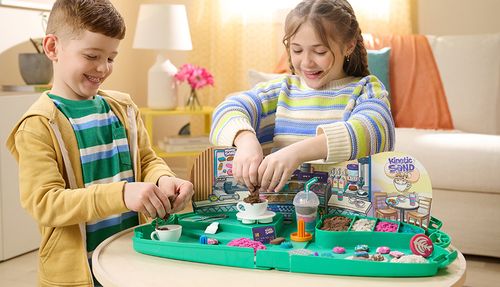
Kinetic Sand Deluxe Set
Sensory regulation and transitions
Pros
- ✓ Very calming tactile input
- ✓ Low noise
- ✓ Easy start/stop
Cons
- ✗ Can get messy
- ✗ Best with tray
- ✗ Not ideal for carpet
Why These Picks Made the List
The Kids' Yoga Deck
The Kids' Yoga Deck is the top pick because it gives a 6-year-old a movement script without needing a screen, a video, or a parent inventing instructions on the spot. Cards make the reset concrete: choose two or three poses, do them together, and call the reset complete. That is often easier than saying, "Go calm down," which is too vague for a tired child.
It works best when an adult participates for the first few sessions. A 6-year-old may not independently choose yoga right after school, but they may accept a tiny ritual: shoes off, snack started, three cards, then free play. The limitation is that cards can scatter and the toy depends on buy-in. If your child strongly resists guided movement, a body sock or tactile option may be a better first reset.
Sensory Body Sock
A sensory body sock gives proprioceptive input: pushing, stretching, curling, and moving against fabric resistance. For sensory seekers, that input can be more regulating than being told to sit still. It gives the body something to do before the child is expected to listen, talk, eat dinner, or start a worksheet.
The key is rules. Use it in a clear space, keep sessions short, and supervise. It is not a wrestling costume or a way to crash into furniture. For many families, the body sock is best as a five-minute movement station before homework or dinner. If your child needs more general sensory options, see Best Sensory Toys for ADHD Kids.
Liquid Motion Bubbler Timer
A liquid motion bubbler timer is useful when the reset needs to get quieter, not bigger. Flip it over, watch the coloured drops move, and let the visual pattern do some of the calming work. It can be a bridge between school stimulation and home expectations because it asks very little from the child.
This is not a high-engagement toy for every kid. Some children watch it for two minutes and are done. That is not necessarily a failure; two quiet minutes may be exactly the reset you need before snack or a conversation. Check for leaks, keep it away from rough throw-and-drop play, and use it as part of a calm-down corner rather than the whole strategy.
Weighted Lap Pad
A weighted lap pad can help during the hardest after-school bottlenecks: homework, reading practice, dinner waiting, or sitting while a parent finishes something. The value is not entertainment. It is grounding pressure that can make stillness feel less effortful.
Choose weight carefully and avoid treating it as a restraint. A child should be able to remove it, and it should feel comforting rather than heavy or punitive. For a 6-year-old who wants to move constantly, combine a lap pad with a short movement break first. Pressure input often works better after the body has had a chance to discharge energy.
Learning Resources Sensory Trio Fidget Tubes
The Sensory Trio Fidget Tubes are a good calm-down corner choice because they offer visual and fine-motor input without batteries, noise, or many separate pieces. A child can twist, watch, squeeze, or inspect the tubes while the nervous system comes down from the school day.
They are not strong enough for every reset. A child who needs to jump, crash, or push may find them too passive at first. In that case, use a movement tool first and the tubes second. They work especially well beside a picture routine: snack, movement, tube timer, then homework or family time.
Kinetic Sand Deluxe Set
Kinetic Sand is a strong tactile reset when you can control the mess. The texture gives hands something satisfying to do, and the play can be open-ended without being loud. For some 6-year-olds, ten minutes of scooping, pressing, flattening, and cutting is enough to make the rest of the evening smoother.
The practical rule is simple: use a tray. Do not make kinetic sand a carpet activity, and do not open the whole set if you only need a short decompression window. Put out a small amount, one or two tools, and a clear finish cue. If tactile play is helpful but mess is the concern, compare Best Calm-Down Toys for After School.
How to Build an After-School Reset Routine
A reset toy works better when the routine around it is predictable. For many 6-year-olds, the order matters more than the exact toy: arrive home, bathroom, snack, body reset, then homework or family responsibilities. If you ask for homework before snack and regulation, the toy may not be the problem; the sequence may be.
Use one toy as the anchor, not six choices at once. Choice can be helpful, but too much choice after school can turn into another demand. Try two options: "Yoga cards or sand tray?" If your child cannot choose, choose for them gently and keep the session short.
Want better toy picks without the research rabbit hole?
Short, practical recommendations by age, need, and budget.
Practical Setup Tips
1) Keep only 3 to 5 toys visible
Fewer options usually means deeper play and less overwhelm. Store backup options out of sight and rotate them when the routine gets stale.
2) Use short play blocks
Try 10 to 20 minute sessions with a clear start and finish. Six-year-olds often do better with "three cards" or "one sand tray timer" than open-ended reset time.
3) Pair movement with calming toys
A quick movement break before table play improves transitions. Use the body sock or yoga deck first, then move to a lap pad, bubbler, fidget tube, or sand tray.
4) Protect the dinner window
Avoid toys that create major cleanup right before dinner. If a tactile toy helps, use a tray and a small amount so the reset does not become another conflict.
5) Repeat the same language
Use a phrase like "body first, brain next" or "reset, snack, homework." Predictable words reduce negotiation because the child knows what the routine means.
FAQ
Are these toys only for kids with a diagnosis?
No. These picks can help many kids who need better focus, calmer transitions, or lower-stimulation play after school. They are regulation supports, not diagnostic tools.
How many toys should we use at one time?
Start with 2 to 3 active reset options. Too much visual choice can reduce sustained attention and increase bargaining when the child is already tired.
What if my child gets more hyper after using a movement toy?
Shorten the movement window and add a calmer second step. For example: two body sock turns, then a liquid timer or lap pad. Movement without a finish cue can ramp some kids up instead of helping them land.
Should reset toys come before homework?
Usually, yes. A short body or sensory reset before homework often prevents a longer battle. Keep it brief and predictable so it does not become avoidance.
Related reads
- Best After-School Reset Toys for 7-Year-Olds
- Best Calm-Down Toys for After School
- Calm-Down Corner Toys That Actually Help
- Best Sensory Toys for ADHD Kids
- Learning Toys for ADHD Kids
If You Can Only Buy One
The Kids' Yoga Deck.
It gives the best balance of guided movement, low setup, parent-child connection, and repeatable after-school reset value for most 6-year-olds.
Want better toy picks without the research rabbit hole?
Get concise recommendations by age, need, and budget.
Where to go next
By age
Best Bedtime Calm Toys for 6-Year-Olds
Keep the recommendations age-appropriate for your kid’s stage.
By need
Gifts for Neurodivergent Kids: A Parent's Guide (2026)
Jump to picks focused on ADHD, sensory, and regulation support.
By budget
Best Gifts for Kids Under $25 (2026)
Compare strong options in lower price brackets before you buy.
Related Articles
Best Toys for Kids Who Rush Through Homework
Four optional short reset activities, with clear stop points, practical limits, and no promise to change homework speed or accuracy.
Read more →
Contained Bedroom Toys: Three Low-Mess Picks
Three contained bedroom toys, with storage, sound, light, timing, and shared-room limits spelled out.
Read more →
Calm Strips vs Marble Mesh Fidget for Classroom Focus
A quiet fidget comparison for school, homework, and kids who need discreet tactile input.
Read more →