Best Montessori Toys for 3-Year-Olds (2026)
10 Montessori-aligned toys that teach through play. Simple, beautiful, and designed to let toddlers figure things out on their own.
Snapshot
| Toy | Age | Price | Best for | Link |
|---|---|---|---|---|
| Grimm's Rainbow Stacker | 1-7 | CAD $45–$70 | Open-ended imaginative and spatial play | Check Price |
| Lovevery Block Set | 1-4 | CAD $90–$120 | First construction set with built-in learning | Check Price |
| Wooden Peg Board (Hape) | 2-4 | CAD $15–$25 | Colour recognition and fine motor skills | Check Price |
| Melissa & Doug Geometric Stacker | 2-4 | CAD $15–$25 | Shape recognition and size sequencing | Check Price |
Affiliate links. Prices can change.
Montessori at home is less about buying a particular look and more about giving a child useful, hands-on work they can begin and repeat with growing independence.
Wooden Rainbow Stacker
Open-ended, beautiful, and endlessly versatile. The quintessential Montessori toy that grows with your toddler.
At age 3, that usually means child-sized tools, a clear purpose, manageable pieces, and a shelf or tray the child can reset. Natural materials can feel pleasant and durable, but wood alone does not make a toy Montessori. A quiet plastic sorting set can be more useful than an expensive wooden object with no clear fit for your child.
This guide mixes formal Montessori-style materials with Montessori-aligned home toys. The rainbow stacker, blocks, and play kitchen are more open-ended than classic single-purpose classroom materials, but they can still support independent, hands-on play at home. If you want strict classroom fidelity, buy from a Montessori-material supplier rather than treating every item below as an exact classroom material.
Quick answer: choose a peg board or geometric stacker for a child who likes clear repetition, threading beads for a child ready to manage small pieces, a pouring set for practical-life practice, and blocks or a play kitchen for longer open-ended play. Skip object-permanence toys if your 3-year-old mastered that stage long ago, and avoid beads or counters while pieces still go in the mouth.
What Makes a Toy Montessori-Aligned at Home
- A clear purpose. The child can understand what the material invites without a long performance from an adult.
- Hands-on feedback. Pouring, sorting, stacking, threading, and matching make the result visible or tangible.
- Independence. The child can carry, begin, use, and eventually return the activity with limited help.
- A manageable challenge. The task is hard enough to practise, but not so complex that the adult takes over.
- Order. Pieces have a tray, basket, or obvious home so resetting is part of the activity.
- Self-correction when it fits. Some materials let the child notice a mismatch without being graded, though open-ended toys do not need one correct answer.
Our Top Picks
Open-ended imaginative and spatial play
Pros
- ✓ 12 rainbow arcs, dozens of uses
- ✓ Bridges, tunnels, fences, figures
- ✓ Gorgeous enough to display
Cons
- ✗ Expensive for wooden arcs
- ✗ No instructions (by design)
- ✗ Large pieces only
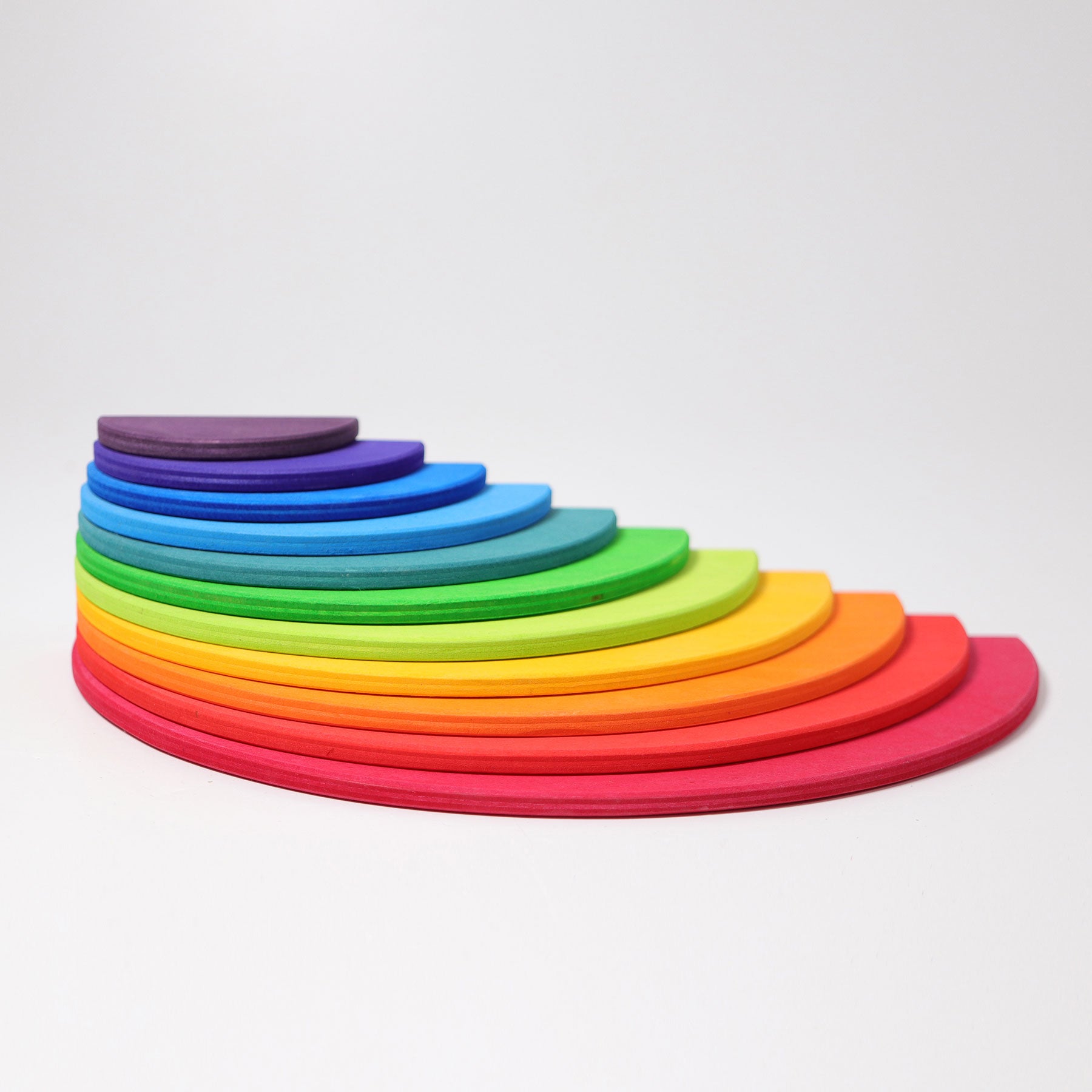
Twelve wooden arcs can become stacks, bridges, tunnels, fences, or parts of a small-world scene. This is closer to Waldorf-style open-ended play than a strict Montessori classroom material, so buy it for flexible building rather than because of the label. It suits a child who already invents uses for loose parts; a child who prefers one obvious task may get more immediate value from a peg board or stacker.
First construction set with built-in learning
Pros
- ✓ 70 pieces designed for developmental stages
- ✓ Includes guidebook for activities
- ✓ Multiple materials (wood, fabric, wheels)
Cons
- ✗ Very expensive
- ✗ Guidebook can feel prescriptive
- ✗ Some pieces are small
The different shapes, sizes, and materials support sorting, balancing, rolling, and construction. The included guide can help an adult offer one small invitation, but it does not need to control the play. This is the high-cost, long-replay option for a child who already returns to blocks; it is poor value if your child mainly wants a short matching task and then moves on.
Colour recognition and fine motor skills
Pros
- ✓ Simple, satisfying peg placement
- ✓ Self-correcting (colours match positions)
- ✓ Perfect hand-eye coordination practice
Cons
- ✗ Limited play variety
- ✗ Pegs roll away
- ✗ Outgrown by 4-5
A board and pegs support colour matching, stacking, patterns, and repeated hand placement. If you present it as a matching activity, use a simple colour card or place one example rather than correcting each choice verbally. The same set can become open-ended later. Watch the frustration point: if the pegs tip easily or roll away, use the board on a shallow tray and offer fewer colours at once.
Shape recognition and size sequencing
Pros
- ✓ Three rods, three shapes, graduated sizes
- ✓ Self-correcting (pieces only fit one way)
- ✓ Painted wood, not plastic
Cons
- ✗ Very simple
- ✗ Short engagement window
- ✗ Paint can chip
Three dowels and graduated pieces create a clear sorting and sequencing task. It is a good first-shelf activity because the start and finish are obvious, but it has a shorter replay window than blocks or a play kitchen. Begin with one shape family if all three rods create too many choices, then add the others once the child understands the routine.
Fine motor skills and concentration
Pros
- ✓ Large colourful beads, easy to grip
- ✓ Wooden lacing string with stiff tip
- ✓ Builds pre-writing hand strength
Cons
- ✗ Beads scatter when dropped
- ✗ Lace frays over time
- ✗ Limited creative scope
Large beads and a lacing cord ask the two hands to do different jobs: one steadies the bead while the other guides the cord. That can be satisfying for a child who likes precise, repeatable work. It can also be a frustrating first pick if the cord bends, the bead holes are tight, or dropped pieces scatter. Offer five or six beads on a tray before handing over the full set, and follow the manufacturer's small-parts guidance.
Independence and concentration
Pros
- ✓ Child-sized pitchers for pouring practice
- ✓ Teaches a real life skill
- ✓ Builds focus and control
Cons
- ✗ Water spills happen
- ✗ Not a 'toy' in the traditional sense
- ✗ Needs a tray and towel nearby
Two small pitchers turn pouring into repeatable practical-life work. Start with a little water on a tray rather than dry rice or beans if loose pieces would be a problem in your home. The useful part is the full routine: carry the tray, pour, wipe a spill, and return the pitchers. A 3-year-old may need help with the reset long after the pouring itself becomes easy.
Understanding that things still exist when hidden
Pros
- ✓ Classic Montessori material
- ✓ Ball goes in, comes out the drawer
- ✓ Endlessly satisfying for toddlers
Cons
- ✗ Very simple (one action)
- ✗ Ball can roll away
- ✗ Short lifespan (most kids master it by 2)
Drop a ball into the hole, find it again, and repeat. This is a younger toddler material, and many children have moved past the core object-permanence lesson well before age 3. Keep it on the list only for a child who still enjoys the posting-and-retrieval action or needs a very simple success loop. For most 3-year-olds, a coin box, peg task, or sorting activity offers a more age-fitting next step.
Maths foundations (sorting, counting, patterns)
Pros
- ✓ Six colours, multiple sizes
- ✓ Matching cups for sorting
- ✓ Endless maths activities
Cons
- ✗ Small pieces (supervision needed)
- ✗ Plastic (not wood)
- ✗ Need parent-led activities for full value
The bears can be sorted by colour or size, counted into groups, copied into patterns, or used for simple story problems. Their value depends on the invitation: a full tub of counters can become floor clutter, while ten bears and two cups create a clear first task. Because the pieces are small, this belongs with children who no longer mouth toys and in homes where younger siblings cannot reach the tray.
Pre-reading and letter recognition
Pros
- ✓ Tactile letter tracing builds muscle memory
- ✓ Multi-sensory learning (see, touch, say)
- ✓ Classic Montessori material
Cons
- ✗ Requires adult guidance initially
- ✗ Only letters (not full reading program)
- ✗ Sandpaper wears smooth over time
Sandpaper letters pair a visible symbol with a tactile tracing path and its sound. They are not an independent toy on day one: an adult normally introduces a small number of letters and models the direction slowly. Choose them when your child is interested in sounds and symbols, not simply because they have turned 3. If the child only rubs the texture or avoids the cards, put them away and return later.
Imaginative play and real-world practice
Pros
- ✓ Mimics real adult activity
- ✓ Builds vocabulary and social skills
- ✓ Years of play value
Cons
- ✗ Takes up space
- ✗ Accessories add up
- ✗ Quality varies hugely by brand
A child-sized kitchen supports role play, language, sequencing, and imitation of everyday routines. It is not a formal substitute for practical-life work: pouring real water, wiping a spill, washing produce, or setting the table gives the child a genuine household contribution. Choose the play kitchen when imaginative cooking already appears in your child's play; choose child-sized real tools when participation is the stronger interest.
Want better toy picks without the research rabbit hole?
Short, practical recommendations by age, need, and budget.
Buying Guide
The Montessori home starter set
If you're starting from zero, do not buy all ten. This smaller menu covers several different ways a 3-year-old might like to work:
1. Grimm's Rainbow (spatial, creative)
2. Peg board (fine motor, colour)
3. Pouring set (practical life, concentration)
4. Threading beads (fine motor, patterns)
5. Sorting bears (maths foundations)
That five-item list is a menu, not a required starter package. Retailer pricing and Canadian availability can change, and you do not need all five at once. One fine-motor activity, one practical-life setup, and one open-ended material are enough to learn what your child returns to before buying more.
Wood vs. plastic
Classic Montessori materials often use wood, metal, glass, or fabric because their weight and texture provide useful feedback. At home, plastic is not an automatic deal-breaker. Choose the material that is safe for your child, easy to keep complete, and suited to the task rather than paying extra for wood on principle.
How many toys at once
A small rotating shelf is easier for a 3-year-old to use and reset than a deep mixed toy bin. Put out four or five activities with visible boundaries: one item per tray or basket, all pieces present, and a clear place to return it. Rotate because an activity is consistently ignored or has become too easy, not on a rigid schedule. Familiar repetition is part of the value.
Frustration, cleanup, and sibling safety
For a child who gives up quickly, start with an activity that has an obvious finish: all pegs placed, all rings stacked, or water transferred once. Demonstrate one slow cycle, then step back. If the child asks for help, reduce the number of pieces before adding verbal instructions. Independence grows from a task the child can actually complete, not from an adult refusing to help.
Keep beads, counters, and other small pieces in a lidded container outside the reach of younger siblings. Put pouring work on a tray with a small cloth, and fill pitchers with only as much water as you are willing to see spilled. Blocks and rainbow pieces need a low basket rather than a tall pile so the child can see choices without emptying everything onto the floor.
Amazon.ca availability was not verified during this refresh, so the existing picks and rough prices should be retailer-checked before purchase. No new affiliate ProductCards were added.
Where to Go Next
- Screen-free math toys for preschoolers
- Learning-through-play toys for 4-year-olds
- Creative toys for when they turn 5
- Screen-free toys for kids
FAQ
Do I need to follow Montessori "rules" to use these toys?
No. Use the practical parts that help your home: child-sized access, a clear demonstration, manageable choices, repetition, and a place to reset the activity. Some materials need more than one introduction, and open-ended toys do not have one correct presentation.
Why are Montessori toys so plain?
Many Montessori materials are visually simple so the relevant feature is easy to notice. That does not mean every colourful, plastic, or electronic toy is useless. Judge whether the design helps the child act, notice feedback, and repeat independently instead of treating a beige wooden finish as proof of educational value.
Are expensive Montessori brands worth it?
Sometimes, if the finish, durability, or range of pieces gives your child more usable play. A premium brand is not required for sorting, stacking, threading, or pouring. Check piece size, stability, finish quality, and how easy the activity is to reset before paying for aesthetics.
What's the most important Montessori principle for home?
Independence. Set up a few activities at your child's height, model how to carry and reset them, and allow time to repeat. Step in for safety or genuine frustration, but help only as much as needed to restart the child's own action. That matters more than owning a particular brand.
Are all wooden toys Montessori toys?
No. Material is only one factor. A useful Montessori-aligned activity has a clear purpose, suits the child's current ability, supports hands-on independence, and can be kept orderly. A wooden toy can still be confusing, too advanced, or purely decorative.
If You Can Only Buy One
Grimm's Rainbow Stacker is the broadest long-replay choice for a child who already likes open-ended building. If your child prefers a clear beginning and finish, the geometric stacker or peg board is the safer first buy. The child's play style matters more than which object looks most Montessori on the shelf.
Want better toy picks without the research rabbit hole?
Get concise recommendations by age, need, and budget.
Where to go next
By age
Best Sensory Toys for Toddlers Ages 1–3 (2026)
Keep the recommendations age-appropriate for your kid’s stage.
By need
Gifts for Neurodivergent Kids: A Parent's Guide (2026)
Jump to picks focused on ADHD, sensory, and regulation support.
By budget
Best Gifts for Kids Under $25 (2026)
Compare strong options in lower price brackets before you buy.
Related Articles
Plus-Plus vs LEGO Classic for Open-Ended Building Play
Which open-ended building toy fits better for independent play, mixed-age creativity, and flexible building sessions?
Read more →
Best Fine-Motor Toys for Early Elementary Kids
Building, threading, peg-placement, and hands-on toys that give early elementary kids distinct kinds of hand-and-finger play.
Read more →
Magna-Tiles vs LEGO Classic for Open-Ended Play
Which open-ended toy wins for focus, creativity, cleanup, and replay value?
Read more →