Best Screen-Free Weekend Toys for 9-Year-Olds
Screen-free toy picks that keep 9-year-olds engaged indoors with less power struggle.
Snapshot
| Toy | Age | Price | Best for | Link |
|---|---|---|---|---|
| #1 ThinkFun Laser Maze | 8+ | CAD $45–$70 | Light-bending logic and spatial reasoning puzzles | Check Price |
| #2 ThinkFun Roller Coaster Challenge | 6+ | CAD $45–$70 | Engineering logic through build-and-test coaster puzzles | Check Price |
| #3 ThinkFun Gravity Maze | 8+ | CAD $45–$70 | Co-solving logic challenges | Check Price |
| #4 Educational Insights Kanoodle 3D | 7+ | CAD $18–$30 | Pocket-size spatial reasoning puzzles | Check Price |
Affiliate links. Prices can change.
At nine, screen-free toys need enough complexity to compete with devices. Simple novelty toys can still buy ten quiet minutes, but they usually do not carry a rainy Saturday, a long family visit, or a weekend morning when everyone needs less arguing and more independent play.
The useful sweet spot is a toy that gives a 9-year-old a real challenge without turning the parent into the entertainment department. Look for logic, building, strategy, creative constraints, and visible progress. The right toy can lower friction, support regulation, and make day-to-day life noticeably easier.
ThinkFun Laser Maze
Reliable engagement, low setup friction, and strong replay value for real family routines.
This guide focuses on screen-free toys that are practical, repeatable, and useful beyond the first week. For slightly younger kids, compare Best Screen-Free Weekend Toys for 8-Year-Olds. If your main problem is weekday decompression instead of weekend boredom, start with Best After-School Reset Toys for 9-Year-Olds.
What to Look For
- Fast entry. If setup is complicated, attention disappears before the play begins.
- Enough challenge. Nine-year-olds need toys that feel capable, not babyish.
- Clear feedback. Kids stay engaged when they can see progress quickly.
- Replay value. Good weekend toys survive past the novelty spike.
- Regulation support. The best toys help kids recover, not just stay busy.
- Manageable cleanup. A toy that wrecks the room may not be worth the quiet window.
Our Top 6 Picks
ThinkFun Laser Maze
Light-bending logic and spatial reasoning puzzles
Pros
- ✓ Distinct science hook
- ✓ Compact challenge cards
- ✓ Strong older-kid puzzle value
Cons
- ✗ Button batteries
- ✗ Mostly solo play
- ✗ Too hard for younger beginners
Engineering logic through build-and-test coaster puzzles
Pros
- ✓ Clear challenge progression
- ✓ Great cause-and-effect feedback
- ✓ Stronger novelty than another circuit kit
Cons
- ✗ Pieces need organization
- ✗ One-player-at-a-time tendency
- ✗ Harder cards may need help
ThinkFun Gravity Maze
Co-solving logic challenges
Pros
- ✓ Great age fit for 9-year-olds
- ✓ Encourages planning
- ✓ Compact setup
Cons
- ✗ Can become one-kid-at-a-time
- ✗ Harder cards may need help
- ✗ Less open-ended than building sets
Pocket-size spatial reasoning puzzles
Pros
- ✓ Tiny footprint
- ✓ No setup beyond opening the case
- ✓ Many challenge levels
Cons
- ✗ Small pieces
- ✗ Mostly solo play
- ✗ Harder puzzles can frustrate
ThinkFun Rush Hour
Quiet logic focus and travel-friendly puzzles
Pros
- ✓ No batteries
- ✓ Portable
- ✓ Great thinking reps
Cons
- ✗ Single-player
- ✗ Can feel hard at first
- ✗ Needs progression support
Structured creativity that scales with age
Pros
- ✓ Huge replay value
- ✓ Scales with age
- ✓ Great imagination tool
Cons
- ✗ Cleanup friction
- ✗ Stepping hazard
- ✗ Can overwhelm if too many pieces out
Why These Picks Made the List
ThinkFun Laser Maze
Laser Maze is the strongest fit for many 9-year-olds because it feels more grown-up than a basic puzzle but still starts quickly. The child places mirrors, blockers, and target pieces on a grid, then tests whether the laser beam reaches the goal. That immediate feedback is what makes it work on a screen-free weekend: the toy gives the next problem instead of requiring an adult to keep inventing activities.
It is especially good for kids who like science, spatial reasoning, or careful problem solving. The challenge cards create progression, so the toy can move from confidence-building wins to real head-scratchers. The limits are worth knowing. It is mostly solo, it uses button batteries, and younger siblings may not be ready for the harder logic. If your weekend goal is collaborative family play, pair it with a building set rather than expecting Laser Maze to carry everyone.
ThinkFun Roller Coaster Challenge
Roller Coaster Challenge is a better pick when a child needs hands-on building, movement, and cause-and-effect testing. A 9-year-old can study a challenge card, arrange the track pieces, release the coaster, and see immediately whether the build works. When it fails, the failure is useful: the track is too low, a piece is misplaced, or the car does not have the right path.
That makes it a strong weekend toy for kids who resist sitting still with a puzzle book but will happily test a physical system. The catch is parts management. This is not the toy to open on a crowded coffee table beside snacks and younger siblings. Use a tray, clear floor space, or a dedicated table block. For a deeper engineering alternative, see Roller Coaster Challenge vs GraviTrax for Engineering Kids.
ThinkFun Gravity Maze
Gravity Maze sits between logic puzzle and marble run. It asks a child to plan a path, predict how the marble will move, and test the result. For 9-year-olds, that is a useful level of challenge: not as open-ended as LEGO, not as passive as a fidget, and not as school-like as a workbook.
This is a good choice for co-solving. Instead of giving instructions, ask one question: "Where do you think the marble goes next?" Then test it. The toy naturally builds sequencing and debugging without needing a lecture. Its weakness is that turns can bottleneck if more than one child wants control, so it is best as quiet solo play or one adult plus one child.
Educational Insights Kanoodle 3D
Kanoodle 3D earns its place because it is tiny, portable, and surprisingly sticky for spatial thinkers. It works well for weekend mornings, restaurants, grandparents' houses, and quiet reset moments when you do not want a whole box of pieces on the floor. The case itself helps contain the toy, which matters more than parents admit.
The frustration risk is real. Harder challenges can feel impossible if a child jumps too far ahead. Start with easier puzzles, celebrate finishing a level, and stop while the toy still feels successful. Because the pieces are small, this is not ideal around toddlers or in places where losing one piece would ruin the set.
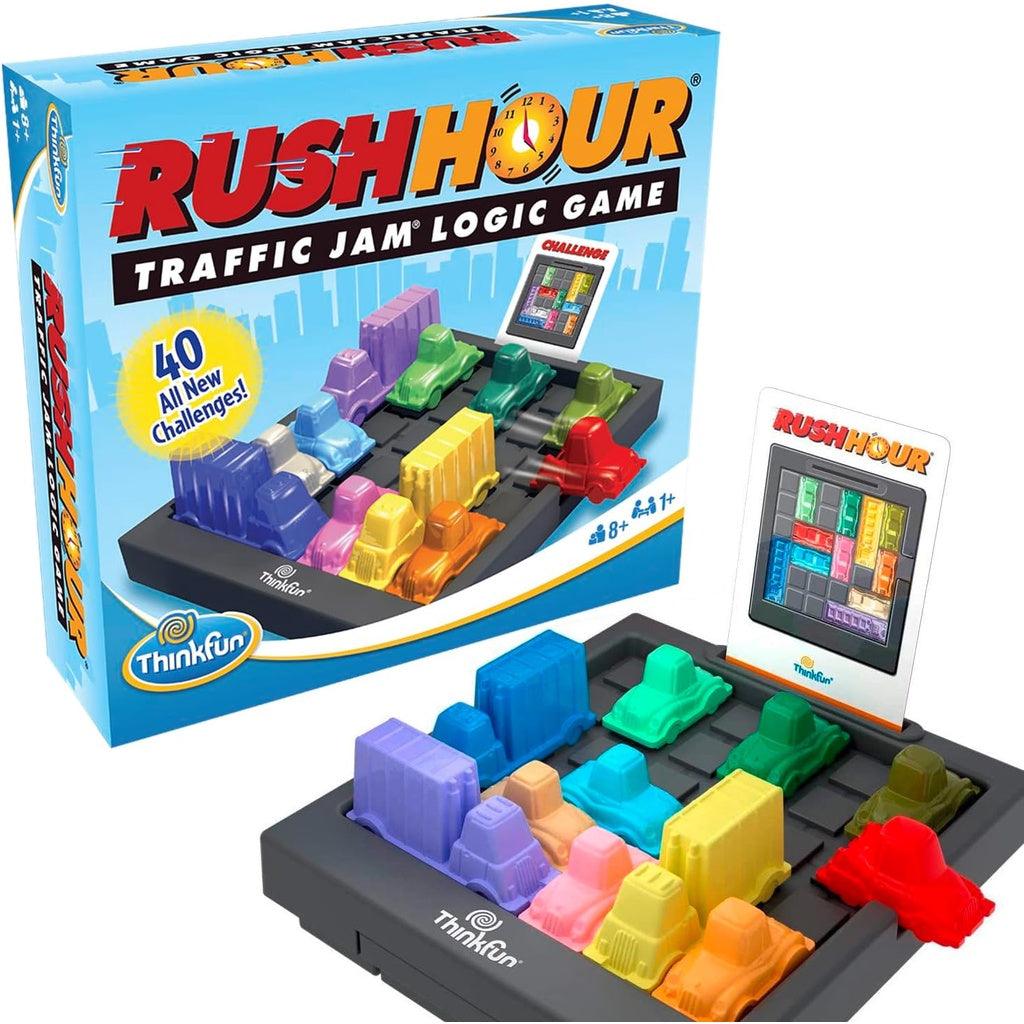
ThinkFun Rush Hour
Rush Hour is a classic for a reason: the goal is instantly understandable, the setup is controlled, and the challenge cards give long-term progression. It is one of the better screen-free toys for a 9-year-old who needs a quiet focus task but does not want crafts, reading, or anything that feels like homework.
The parent move is to avoid over-teaching. If a child gets stuck, ask, "Which car blocks the red car first?" and then pause. Too much adult narration turns a good logic toy into a lesson. Rush Hour is also a useful travel bridge; if road trips are the bigger need, compare Best Road Trip Toys for 9-Year-Olds.
LEGO Classic Medium Creative Brick Box
LEGO is the most open-ended option here. For a 9-year-old, the best use is not dumping every brick onto the floor and hoping inspiration arrives. It works better with a constraint: build a creature, design a room, make a bridge that holds a book, recreate a scene, or invent a vehicle with only twenty pieces.
That kind of prompt gives structure without killing creativity. LEGO also has the best sibling and family-play potential on this list. The downside is cleanup friction and visual overwhelm. If your child gets lost in too many options, put a smaller selection in a bin and rotate the rest back in later.
How to Choose for Your Weekend
Choose Laser Maze if you want compact solo challenge with a science hook. Choose Roller Coaster Challenge if your child needs physical building and visible testing. Choose Gravity Maze if co-solving and spatial logic are the goal. Choose Kanoodle 3D or Rush Hour if you need portability and quiet focus. Choose LEGO if your weekend needs open-ended creative play and sibling flexibility.
For kids who default to screens when bored, the first session matters. Do not present the toy as a replacement for a device in the middle of a conflict. Introduce it during a calmer window, start with an easy win, and leave before the toy becomes associated with pressure. Screen-free play works better as an available path than as a punishment.
Want better toy picks without the research rabbit hole?
Short, practical recommendations by age, need, and budget.
Practical Setup Tips
1) Keep only 3 to 5 toys visible
Fewer options usually means deeper play and less overwhelm. Put the rest away so the visible choices feel fresh.
2) Use short play blocks
Try 15 to 25 minute sessions with a clear start and finish. A good short session is better than a forced hour that ends in frustration.
3) Pair movement with focus toys
A quick movement break before table play improves transitions. Ten wall pushes, a walk around the block, or carrying laundry upstairs can make puzzle play easier.
4) Rotate weekly
Rotation keeps engagement high without constant new purchases. Bring back a toy after two or three weeks and it often feels new again.
5) Store challenge toys ready-to-play
Keep cards, pieces, batteries, and instructions together. Weekend toys lose their value when the first ten minutes are spent searching for missing parts.
FAQ
Are these toys only for kids with a diagnosis?
No. These picks can help many kids who need better focus, calmer transitions, or lower-stimulation play. They are useful because they create structure and feedback, not because they are medical tools.
How many toys should we use at one time?
Start with 3 to 5 active options. Too much visual choice can reduce sustained attention, especially on tired or overstimulating weekends.
What if my child gets bored quickly?
Use short sessions, rotate weekly, and focus on toys with immediate feedback and open-ended replay. Also check whether the toy is too easy. Some 9-year-olds reject screen-free play when the available options feel too young.
What if siblings want to join?
Choose LEGO or Roller Coaster Challenge for shared play, then use Laser Maze, Rush Hour, Gravity Maze, or Kanoodle as separate quiet stations. One-player puzzle toys can still work in sibling households if each child has a clear turn or their own task.
Related reads
- Best Screen-Free Weekend Toys for 8-Year-Olds
- Best Road Trip Toys for 9-Year-Olds
- Best Toys for Kids Who Get Bored Easily
- Best Gifts for Kids Under $25
- Best Travel Toys for Airplanes with Kids
If You Can Only Buy One
ThinkFun Laser Maze.
It gives the best balance of calm engagement, older-kid challenge, compact storage, and long-term replay for most 9-year-olds who need a stronger screen-free weekend option.
Want better toy picks without the research rabbit hole?
Get concise recommendations by age, need, and budget.
Where to go next
By age
Best Homework Break Toys for 9-Year-Olds
Keep the recommendations age-appropriate for your kid’s stage.
By need
Gifts for Neurodivergent Kids: A Parent's Guide (2026)
Jump to picks focused on ADHD, sensory, and regulation support.
By budget
Best Gifts for Kids Under $25 (2026)
Compare strong options in lower price brackets before you buy.
Related Articles
Mental Blox vs Rush Hour Junior for Logic Skills
Compare two low-tech logic toys for kids who need more thinking reps without screens.
Read more →
Monster Scale vs Numberblocks MathLink Cubes for Preschool Math
Compare two hands-on math toys for early counting, number sense, and quiet learning play.
Read more →
Best Calm Waiting-Room Toys for Kids
Small quiet toys for appointments, restaurants, waiting rooms, and other moments where kids need help staying regulated.
Read more →